IMEI Register Format for Mobile Shops
Every phone that crosses your counter — for repair, bought from a customer, or sold — should leave one line in a register with its IMEI. Here are the columns that line needs, why each one matters, and where a paper book stops being enough.
What an IMEI Register Is
IMEI is the 15-digit number that identifies one handset. A dual-SIM phone has two. An IMEI register (also called a mobile register book or second-hand mobile register) is a running list of every phone the shop handled, with that number, the person who brought it, and what happened to it. Shops that buy and sell used phones keep it because police ask for it. Repair shops keep the same details on the job card. The point is the same: if anyone asks about a handset later, you can say who brought it, when, and in what condition.
Register Format
The columns every IMEI register needs
Rule a register book with these columns, or set up a sheet the same way. Group them in five blocks so a busy counter fills them in the same order every time:
Entry details
- Serial / entry number (one per phone, never reused)
- Date and time the phone came in
- Type of entry: repair, bought from customer, sold, returned
The person
- Full name and mobile number
- Address (for a seller, the full address on their ID)
- ID proof type and number — Aadhaar, driving licence, voter ID — for anyone selling you a phone
The phone
- Brand and exact model (e.g. Redmi Note 12 5G, not just 'Redmi')
- IMEI 1 and IMEI 2 — all 15 digits, read from *#06#, not only from the box
- Colour, RAM / storage
- Serial number for tablets, laptops and anything without an IMEI
Condition and what came with it
- Physical condition: cracks, dents, swollen battery, missing screws
- Whether the Google / iCloud account is still logged in
- Accessories handed over: charger, cable, box, bill, SIM tray, cover
Money and paper
- Price paid or charged, and how (cash, UPI with reference)
- Original bill seen? Bill date and shop name if yes
- Signature or thumb impression of the person, and of the staff member who took the entry
Why It Matters
Three times the register saves you
- Police verification: When a stolen phone is traced to a shop, the first question is who sold it to you. A register with the seller's name, address, ID number and signature is your answer. Without it, the shop is the last known holder of the phone.
- Stolen and blocked phones: A phone blocked on its IMEI is worth nothing to the next buyer. Checking the IMEI before you buy, and writing down that you checked, keeps those phones out of your stock in the first place.
- Warranty and repeat repairs: When a customer says 'you changed this screen two months ago', the IMEI finds the earlier job in seconds — what was replaced, when, and the warranty period you gave. It also settles 'this is not my phone' disputes at delivery.
The Mistake: Copying the IMEI From the Box
The box can belong to a different phone. Always dial *#06# on the handset itself and copy that number. Then compare it with the box and the bill. If they don't match, note it in the register before you take the phone, not after.
Paper Register vs Digital Register
A ruled register book works, and for a shop that buys two used phones a month it may be all you need. It breaks in three places:
- Searching: when someone gives you an IMEI and asks if the phone passed through your shop, you are turning pages across several books.
- Handwriting: one wrong or unreadable digit in fifteen and the entry is useless. A 6 that looks like a 0 is enough.
- ID copies: photocopies of Aadhaar cards stapled into a book fade, tear and get lost.
A digital register keeps the same columns, refuses an IMEI that is the wrong length, and finds any phone by its number in one search.
How Kiwikit Keeps the IMEI Register
Kiwikit does not have one separate "register book" screen. The IMEI is recorded where the phone actually enters the shop, and each of those places is searchable by IMEI:
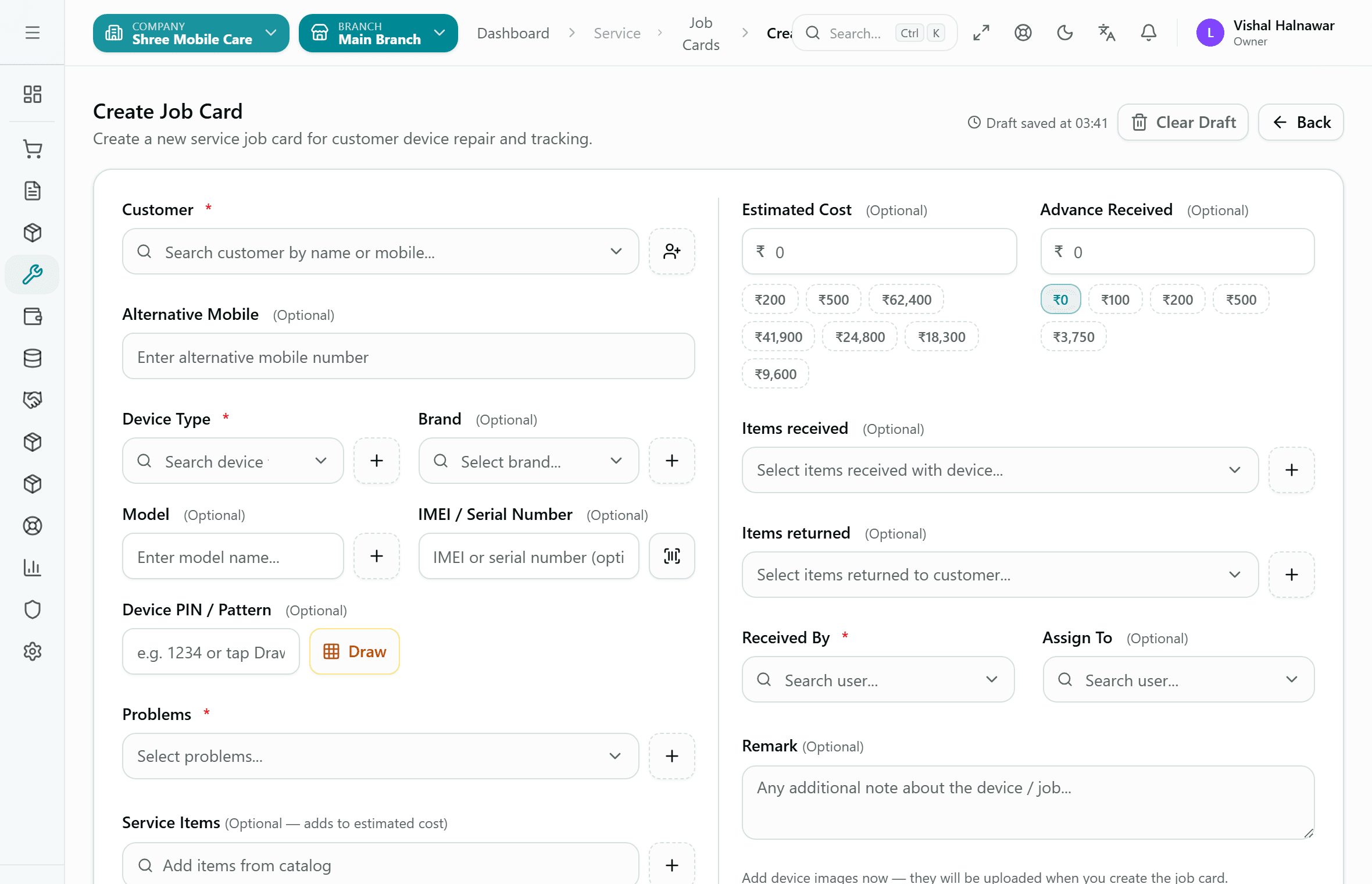
- Repairs — the job card: customer and mobile, device type, brand, model, colour, the phone's PIN or pattern, the problem, and the accessories kept with the phone or handed back. It takes one IMEI, which must be exactly 15 digits, or a serial number for laptops and other devices. The job card list can be searched by IMEI or serial.
- Buying a used phone — Device Purchase: IMEI 1, IMEI 2 or serial number, condition grade (A / B / C) with notes, whether the Google / iCloud lock is still on, accessories, photos, the seller's ID proof type and number with photos of the ID, an "IMEI verified" tick, and the seller's declaration that the phone is theirs to sell, timestamped when it is taken. Kiwikit refuses to buy an IMEI that is already in your device stock. Purchase Register and Sale Register screens list every device bought and sold.
- The seller's declaration form — Used Device Purchase: the seller's name, address, mobile and ID, the phone's IMEI 1 and 2, RAM, storage and colour, where and when the seller bought it, and which items are missing (box, bill, charger, headset). Photos of the ID, the seller and the bill are attached. It prints as a two-page A4 sheet for the seller to sign, can be searched by IMEI, and saving it creates the purchase bill and adds each phone to stock by its IMEI.
- New phones in stock: an item set to IMEI tracking stores each handset as its own piece with IMEI 1, IMEI 2 and serial. The same IMEI cannot be in stock twice, and a purchase bill tells you if a scanned IMEI is already on the shelf.
Buying and selling used phones is most of your work? See Kiwikit for second-hand mobile shops.
Frequently Asked Questions
Where do I find a phone's IMEI number?
Dial *#06# on the phone and it shows the IMEI (two numbers on a dual-SIM phone). It is also printed on the box, on the SIM tray or back panel of many models, and in Settings → About phone. If the number on the screen and the number on the box don't match, write that down and ask the customer why before you take the phone.
Do I need to record both IMEI numbers on a dual-SIM phone?
Yes, for any phone you buy or sell. A police query or a blocked-phone check can name either IMEI. If your register only has IMEI 1 and the query names IMEI 2, you will not find the phone in your own book.
Is a register needed for repairs, or only for second-hand phones?
A second-hand purchase register with the seller's ID proof is the one police ask for. For repairs, the IMEI on the job card does the same job on a smaller scale: it proves which handset came in and went out, and lets you find the earlier repair when the same phone comes back.
How do I check that a phone is not reported stolen before buying it?
The Department of Telecommunications' Sanchar Saathi portal has a 'Know Your Mobile' check where you enter the IMEI and see its status. Do it at the counter before you pay, and note in the register that you checked.
How long should I keep the IMEI register?
Keep it for years, not months. Queries about a phone can come long after you bought or sold it. A paper book should be stored safely once it is full; a digital register keeps every entry searchable without a cupboard of old books.
Read next
The repair side of the same record is the mobile repair job card format. Keeping phones and spares on the shelf? Read repair shop inventory management, or see Kiwikit inventory software.
Try Kiwikit Free for 3 Days
IMEI on job cards, used-phone purchases with seller ID and declaration, and phones in stock by IMEI 1 and 2 — all searchable by number.